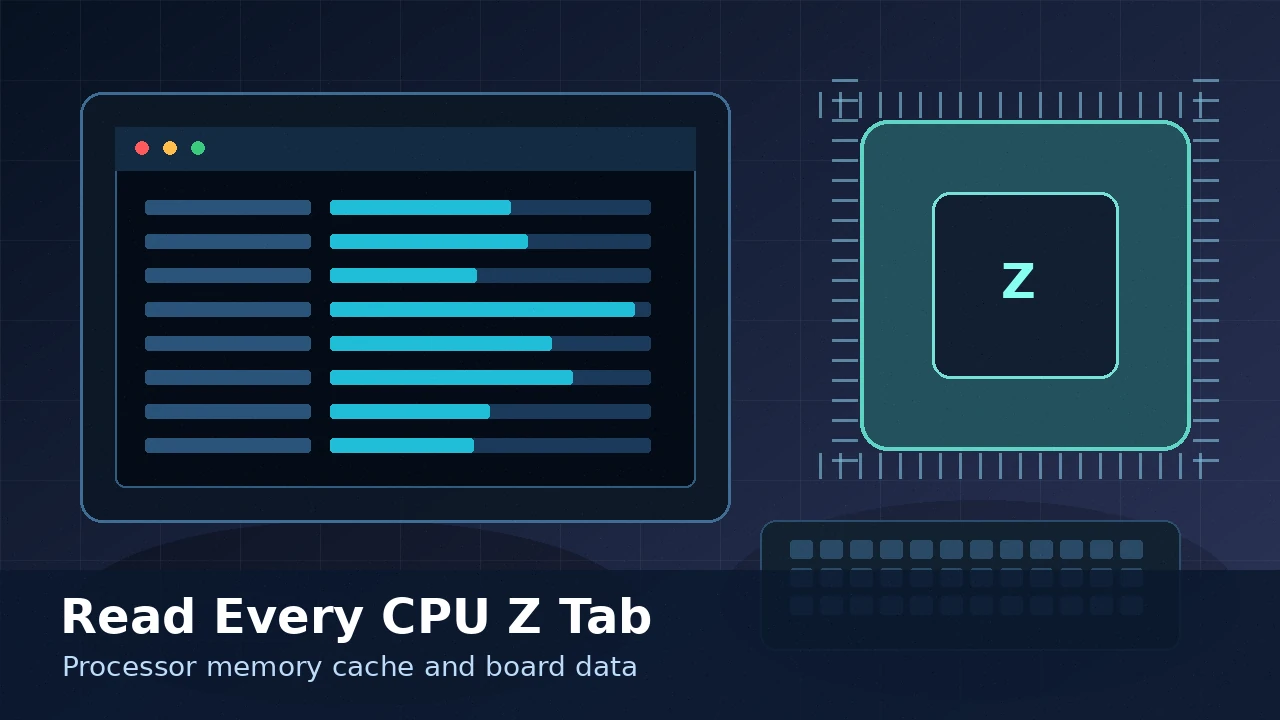
Open CPUZ for the first time and it can look like a wall of acronyms. But each tab answers a specific question about your PC. Here's what every one is telling you, in plain language.
The CPU tab
This is the home screen and the most useful panel. It identifies your processor and shows what it's doing right now.
- Name & Code Name: the marketing name (e.g. Ryzen 7 9800X3D) and its architecture code name.
- Package & Technology: the socket type and manufacturing process node.
- Core Speed, Multiplier, Bus Speed: these update live. Core Speed = Bus Speed × Multiplier, and it rises and falls as your CPU boosts or idles.
- Core Voltage (VID): the voltage feeding the cores — important when tuning.
- Cores & Threads: physical cores and logical threads.
The Caches tab
Here you'll see the size and descriptor of each cache level — L1 data and instruction, L2 and L3. Larger, faster cache helps performance, which is why chips with extra L3 (like 3D V-Cache models) are popular for gaming.
The Mainboard tab
This panel describes your motherboard and firmware:
- Manufacturer, Model, Revision: exactly which board you have.
- Chipset & Southbridge: the platform controlling your CPU's features.
- BIOS brand, version and date: handy when checking whether a firmware update is available.
The Memory tab
The Memory tab reports how your RAM is currently running:
- Type & Size: e.g. DDR5 and total capacity.
- Channel: single, dual or quad — dual channel is important for performance.
- DRAM Frequency: remember to double it for the advertised speed on DDR (a 3000 MHz reading equals DDR-6000).
- Timings (CL, tRCD, tRP, tRAS): the latency figures that, together with speed, define memory performance.
The SPD tab
SPD reads each memory slot individually. Select a slot to see the module's manufacturer, part number, capacity, and the JEDEC and XMP/EXPO profiles it supports. This is the tab to use when confirming that a RAM kit matches what you bought — see our PC verification guide.
The Graphics tab
A lighter readout for your active graphics adapter: GPU name, clocks and memory. It won't replace a dedicated GPU tool, but it's enough to confirm which card is installed and roughly how it's clocked.
The Bench tab
CPUZ includes a quick single- and multi-thread benchmark with reference scores. It's handy for a sanity check — comparing your chip against a reference CPU — though dedicated benchmarks are better for serious comparison.
The About tab and Validate
The About tab shows the program version and gives you the Tools menu, where you can:
- Save Report to a TXT or HTML file capturing every tab at once — perfect for support tickets and build logs.
- Validate to publish a verified spec snapshot online that you can link to.
If Core Speed looks low at idle, that's normal — modern CPUs down-clock to save power. Load the system and you'll see it jump to its boost frequency.
Common misreadings to avoid
- "My RAM runs at half speed." It doesn't — DDR memory shows half the rated number because data transfers happen twice per cycle.
- "CPUZ shows the wrong CPU." Very new hardware needs a newer build; update CPUZ.
- "Where's the temperature?" CPUZ doesn't measure it — pair it with HWMonitor (our temperature guide).
Want to follow along?
Download CPUZ and open each tab as you read.
Once you know what each tab represents, CPUZ stops being a wall of jargon and becomes the quickest way to understand — and document — exactly what your PC is made of.
Putting it together: a worked example
Imagine you just enabled your RAM's EXPO profile and want to confirm it worked. You'd open the Memory tab, read DRAM Frequency, double it, and check it matches your kit's rating. Then you'd switch to SPD to confirm the right profile is present on each stick. Two tabs, thirty seconds, total certainty — that's the CPUZ workflow in a nutshell.
Saving and using reports
The Save Report option under Tools writes every tab to a single TXT or HTML file. That's more useful than it sounds:
- Attach it to a support ticket so technicians see your full configuration at once.
- Keep it as a record before and after a hardware change.
- Include it in a sale listing to prove exactly what a system contains.
Reading the Bench tab sensibly
CPUZ's benchmark gives a quick single- and multi-thread score against a reference processor. Treat it as a sanity check rather than a definitive ranking: it's great for confirming your chip performs roughly as expected, but dedicated benchmarking suites are better for careful comparisons between systems.
Where to go next
Now that the numbers make sense, you can use them with purpose: verify a new PC against its spec sheet, or follow live clocks and voltage while overclocking. The same tabs you just learned power both of those workflows, so the time you spent here pays off twice.
Key takeaways
- The CPU tab shows identity plus live clock, multiplier and voltage.
- Memory and SPD reveal speed, timings and per-slot module details.
- Live core speed updates as your CPU boosts and idles.
- Save a full report from Tools to document everything at once.